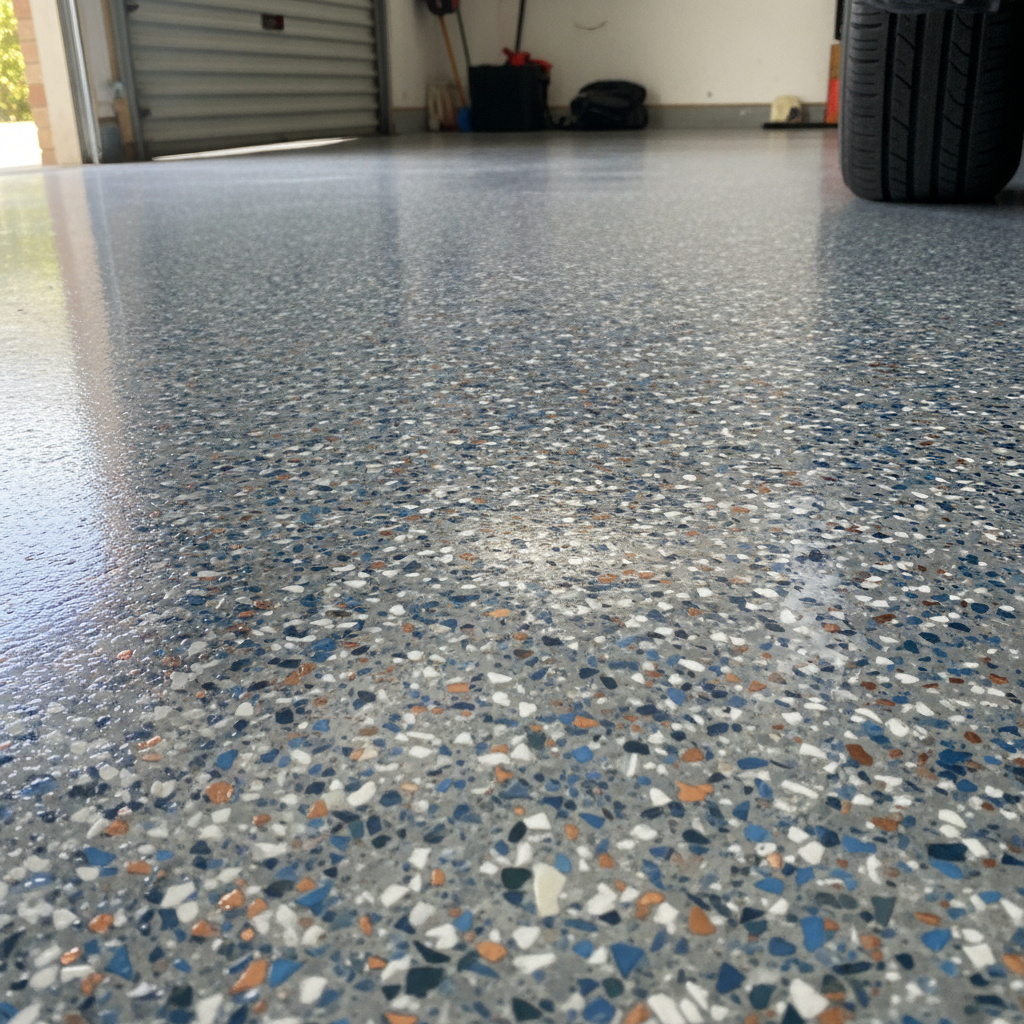
Garage Flooring Options for Melbourne Homes: A Complete Guide
Garage flooring options for Melbourne homes range from bare concrete sealer through to interlocking tiles, polyurea coatings and full epoxy systems. Epoxy floor coatings are the most popular choice for durability, cleanability and finish quality. The right pick depends on how you use the space, your budget and how long you want it to last.
Why does Melbourne’s climate matter for garage flooring?
Melbourne’s climate matters for garage flooring because the city’s wide temperature swings, from below 5°C in winter to over 40°C in summer, put real stress on floor coatings and tiles. A product that bonds or expands poorly with temperature change will crack, peel or lift within a season or two, costing you more in the long run.
Concrete slabs in Melbourne also deal with moisture rising from the ground. Older homes in suburbs like Footscray, Preston and Frankston often have slabs that were poured without a proper moisture barrier. If a coating is applied over a damp slab, it will bubble and delaminate no matter how good the product is. That is why surface preparation, specifically grinding and moisture testing, is the single most important step in any garage floor job.
Heat is a factor too. A dark, sealed garage in summer can easily sit at 50°C. Standard epoxy floor paint from a hardware store is not formulated for those conditions. It softens, scuffs and loses its gloss within a year. Professionally applied, solvent-free or 100% solids epoxy systems are far thicker and far more heat-stable.
What are the main garage flooring options available in Melbourne?
The main garage flooring options available in Melbourne are bare concrete sealer, epoxy paint, broadcast flake epoxy systems, polyurea or polyaspartic coatings, interlocking PVC tiles, and rubber matting. Each sits at a different price point and delivers a different level of protection, finish and longevity.
Here is a plain-English breakdown of each one:
Bare concrete sealer. A penetrating or topical sealer is the cheapest entry point, typically under $10 per square metre in materials. It keeps dust down and makes the slab easier to sweep. It offers no real impact or chemical resistance, though, and won’t do much for the look of the space.
Epoxy floor paint (DIY tin). Water-based epoxy paints sold at hardware chains are easy to apply but they are genuinely thin, usually around 100 microns dry film thickness. That compares poorly to a professionally installed two-part epoxy system, which can be laid at 1,000 microns or more. The DIY product tends to peel within a couple of years, especially if the slab wasn’t properly prepared.
Broadcast flake epoxy systems. This is the finish you see in showrooms and high-end home garages. Coloured vinyl flakes are broadcast into a wet epoxy base coat, then locked in with a clear topcoat. The result is a tough, attractive surface that hides minor imperfections, provides slip resistance and is very easy to clean. Film thickness is high, and when installed over a properly ground slab the system can last 10 to 15 years in a domestic garage.
Polyurea and polyaspartic coatings. These are faster-curing, more UV-stable alternatives to standard epoxy. They can be walked on within hours of application and they don’t yellow the way some epoxies can when exposed to sunlight through a window. They are generally more expensive but suit garages that double as workshops or entertaining areas.
Interlocking PVC tiles. Snap-together tiles are a no-preparation DIY option. They sit on top of the existing concrete and can be lifted and relaid. The downsides are the seams, which collect grime, and the fact that the tiles can shift under vehicle tyres. They suit a workshop corner or a gym conversion more than a full garage bay.
Rubber matting. Roll-out rubber matting is common in gyms and workshop areas. It provides good cushioning and anti-fatigue properties but offers no protection to the slab beneath and can trap moisture, leading to mould and slab staining over time.
How long does garage flooring last in a typical Melbourne home?
Professionally installed epoxy garage flooring lasts 10 to 20 years in a typical Melbourne home when the slab is properly prepared beforehand. DIY paint-on products average two to four years. Interlocking tiles last indefinitely as a product but the surface finish wears and the joints open up after a few years of daily vehicle traffic.
Longevity comes down to three things: prep, product quality and foot (or tyre) traffic. A diamond-ground slab gives the coating mechanical adhesion that sticking tape can’t match. A 100% solids epoxy or polyaspartic product is simply denser and harder than a water-based paint. And a garage that parks two SUVs daily wears faster than one that houses a weekend classic car.
Maintenance matters too. Epoxy and polyaspartic surfaces should be cleaned with a neutral-pH cleaner rather than harsh degreasers or acidic products, which can dull the topcoat over time. A rinse with a garden hose and a mop is usually all a domestic garage needs.
What does garage flooring cost in Melbourne?
Garage flooring in Melbourne costs roughly $30 to $80 per square metre installed for a professional epoxy or polyaspartic system, depending on the product specified, the size of the garage and the condition of the existing slab. A standard two-car garage of around 36 square metres typically falls in the $1,500 to $2,800 range for a quality broadcast flake epoxy installation.
DIY options are cheaper upfront. A two-part epoxy paint kit for a single garage bay costs around $150 to $300 in materials. Factor in the limited lifespan and the cost of reapplying every two to three years, and the economics of a professional system start looking much better over a five-year horizon.
Extra costs to budget for include crack repair, moisture remediation on older slabs and any removal of existing coatings. A good installer will assess all of this at the quote stage rather than hit you with surprises mid-job. Always ask whether the quote includes diamond grinding, because grinding is what makes or breaks the adhesion.
Which garage flooring option is best for a Melbourne home?
A broadcast flake epoxy system installed over a diamond-ground slab is the best garage flooring option for most Melbourne homes. It balances cost, durability, appearance and slip resistance better than any other product at the same price point. For garages with significant UV exposure or where a very fast turnaround is needed, a polyaspartic topcoat is worth the extra spend.
If you are converting a garage into a gym or workshop rather than parking vehicles in it, interlocking rubber or PVC tiles over a sealed slab are a reasonable secondary choice. They can be changed or extended cheaply as the space evolves.
The honest answer is that the best product is the one that suits how you actually use the space. A tradie who parks a ute and stores chemicals needs something different from a homeowner who wants an entertainer-style showroom finish. Getting a professional to look at the slab and talk through the use case saves a lot of regret later.
Ready to sort your garage floor? Get a garage flooring quote in Melbourne