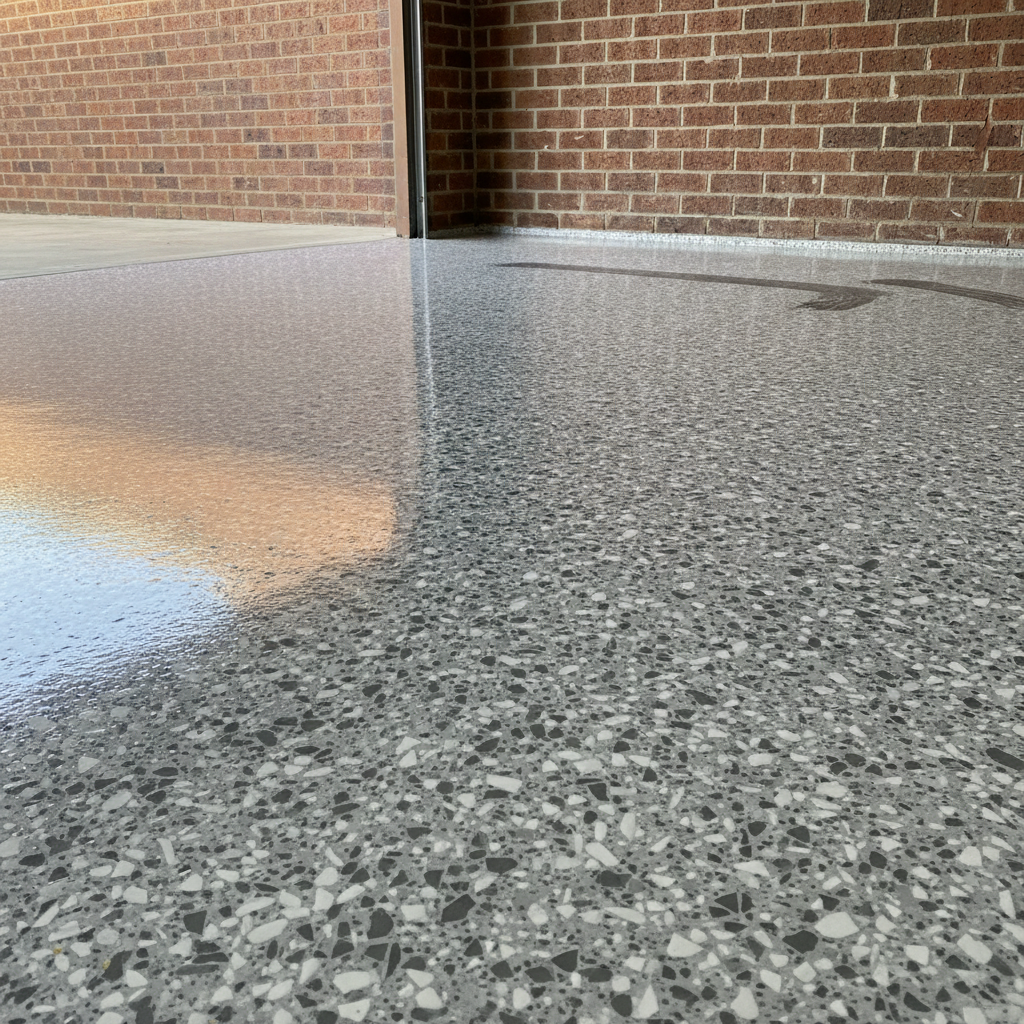
Garage Floor Ideas for Essendon Homes: Epoxy, Flake and Beyond
The best garage floor ideas for Essendon homes combine a hard-wearing coating with a finish that suits the home’s style. Epoxy base coats topped with decorative flake are the most popular choice because they resist oil, tyre scuff and Melbourne’s temperature swings while looking far sharper than bare concrete. Expect a properly installed system to last well over a decade with minimal upkeep.
Why does bare concrete make such a poor garage floor in Essendon?
Bare concrete is porous, which means oil drips, brake fluid and garden chemicals soak straight in and stain permanently. Essendon’s older homes, many built between the 1940s and 1970s, often have slab concrete that has never been sealed. That concrete absorbs moisture, dusts constantly underfoot and starts to spall or flake at the surface after years of traffic and seasonal expansion. Once it gets to that point, sweeping is a battle you never quite win, and the dust ends up on your car, your tools and your workbench. A coated floor fixes all of that in a single job.
What are the most popular garage floor coating options available today?
The most popular garage floor coating options are epoxy base coats, polyaspartic topcoats, vinyl flake systems and polyurea blends. Each suits a different budget and performance need. Epoxy provides excellent adhesion and chemical resistance. Polyaspartic cures faster and handles UV exposure better outdoors. Vinyl flake adds grip and hides minor surface imperfections. Polyurea is extremely durable but typically costs more per square metre.
Here is a quick breakdown of how those options stack up for a typical Essendon double garage (roughly 40 to 50 square metres):
- Solid epoxy coat: Clean, gloss finish. Great for workshop spaces where you want maximum chemical resistance.
- Epoxy base with vinyl flake broadcast: The most requested finish. Flakes hide minor surface texture, add slip resistance, and come in dozens of colour blends to match the home’s exterior palette.
- Metallic epoxy: A single-colour, pearlescent finish that creates a flowing, three-dimensional look. Popular in newer homes where the garage is partly a showroom for the car collection.
- Polyaspartic topcoat over epoxy base: The two-coat system used by professional applicators. The polyaspartic layer is harder, UV-stable and fully cured in around 24 hours, which matters when you need the car back in the garage quickly.
How does a flake system work for a garage floor coating?
A flake system works by broadcasting small vinyl colour chips into a wet epoxy base coat at a controlled density, then locking them under a clear topcoat. The chips are pressed flat during the topcoat stage, creating a smooth surface that still has subtle texture for grip. Broadcast density can range from a light scatter to a full broadcast that completely hides the base colour underneath.
Full broadcast flake is particularly practical for Essendon homeowners because it hides hairline cracks, minor pitting and the uneven colour that is common in older slabs. The topcoat, usually a polyaspartic or aliphatic urethane, is what gives the floor its gloss level and its resistance to tyre marks. A quality topcoat applied at the right film thickness means tyres can spin on the spot without leaving the black scuffs you see on cheaper single-coat systems.
Colour choice matters more than people expect. Essendon homes tend to run toward classic heritage palettes: Federation reds, cream weatherboards and dark Colorbond roofs. A flake blend in grey, charcoal and white reads as clean and contemporary without clashing with those exterior tones. Warmer blends in beige, tan and brown suit homes with timber garage doors and sandstone render.
What preparation does a concrete slab actually need before coating?
Concrete preparation is the step that determines whether a coating lasts five years or fifteen. Diamond grinding is the industry standard method: it opens the concrete’s pores mechanically so the epoxy bonds at a chemical level rather than just sitting on top. Shot blasting is used on larger commercial floors but is less common in residential garages.
Beyond grinding, the installer needs to check for moisture. Essendon sits on Melbourne’s basalt plain, and many older slabs have no membrane underneath them at all. A simple calcium chloride test or a surface relative humidity probe will reveal whether moisture vapour is migrating up through the slab. If it is, a moisture-tolerant primer goes down before the epoxy base. Skipping this step is the number one reason DIY epoxy kits fail: the coating lifts at the edges within a year because the moisture has nowhere else to go.
Crack repair is the other key prep task. Hairline cracks can be filled and ground flat. Structural cracks, the type that move with the seasons, need a flexible filler rather than a rigid epoxy paste, otherwise the crack telegraphs back through the coating.
How long does a garage floor coating take to install and cure?
A typical residential garage floor coating takes one to two days on-site, with a full return-to-vehicle cure of around 24 to 72 hours depending on the system. Polyaspartic topcoats cure significantly faster than standard epoxy, which is why most professional applicators now use them as the finishing layer. Ambient temperature and humidity on the day affect cure time, and Melbourne’s shoulder seasons (autumn and spring) are generally ideal conditions for epoxy work.
The grinding and prep normally happen on day one. Base coat and flake broadcast go down the same day or early on day two. The topcoat follows once the base has cured to the right hardness. Most homeowners park a light vehicle back on the floor within 48 hours and return to full use within a week.
What are the practical benefits of a coated garage floor for Essendon homeowners?
A coated garage floor in Essendon delivers four clear practical benefits beyond appearance. First, cleaning drops to a quick sweep and occasional mop: oil and grease sit on the surface rather than soaking in. Second, the reflective finish bounces light around the garage, which makes working in the space noticeably safer and more comfortable without adding extra lighting. Third, a professionally installed coating adds tangible value to the property, particularly as Essendon’s real estate market continues to reward well-presented homes. Fourth, the coating protects the slab itself, slowing the deterioration that leaves bare concrete increasingly expensive to repair over time.
For tradies who use the garage as a workshop, the slip resistance built into a flake system is a genuine safety improvement over smooth concrete, especially when the floor gets wet from washing a car or a bit of Melbourne rain blowing in under the door.
Is a garage floor coating a DIY job or better left to a professional?
Garage floor coating is not a straightforward DIY job for most homeowners. The prep work alone, diamond grinding, crack filling, moisture testing, requires equipment that most people do not own and skills that take time to develop. DIY epoxy kits sold at hardware stores use thinner formulations than trade-grade products, and without proper surface preparation the results rarely last more than two or three years before peeling begins. A professional applicator using a proper multi-coat system will charge more upfront, but the cost per year over a 15-plus year lifespan works out considerably lower than patching or redoing a failed DIY attempt.
That said, homeowners can absolutely prepare by clearing the garage completely before the crew arrives, checking for oil stains that might need a degreaser pre-treatment, and deciding on a flake colour blend before the quote visit so the conversation is productive from the start.
Get a garage floor coating quote in Essendon from Metal and Flake.