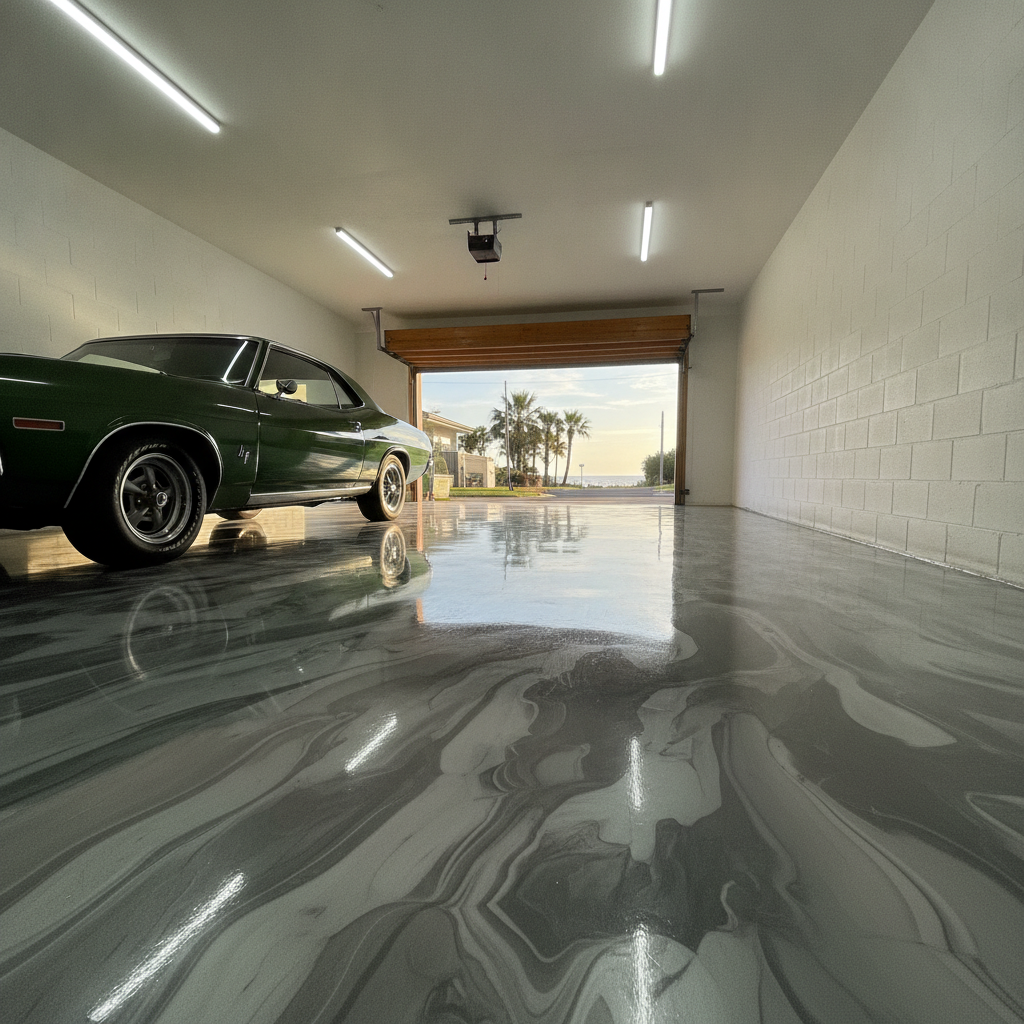
Metallic Epoxy Floors in Williamstown: Coastal Home Garage Guide
Metallic epoxy in Williamstown is a popular garage flooring choice because it combines a high-gloss, three-dimensional finish with a surface tough enough to handle salt air, tyre traffic and the general demands of a coastal home. Installed correctly over prepared concrete, a metallic epoxy system typically lasts well over a decade with minimal upkeep. It suits both single garages and large double bays.
Why do Williamstown homeowners keep choosing metallic epoxy for their garages?
Williamstown homeowners choose metallic epoxy because it holds up against the moisture and salt exposure that come with living close to Port Phillip Bay, while delivering a finish that looks far more polished than a standard grey concrete slab. The swirling, pearlescent effect also photographs well, which matters if you’re renovating ahead of a sale.
Drive down any street near the Williamstown waterfront and you’ll spot garages that have clearly been upgraded. Part of that is the suburb itself: it’s an older, character-rich area where people invest seriously in their homes. Garage floors are no longer an afterthought. They’re part of the overall presentation, and a metallic epoxy system with its liquid-marble look can genuinely make a bland garage feel like an extension of the house.
From a practical standpoint, a fully sealed epoxy floor resists the salt-laden moisture that drifts in off the bay. Bare concrete is porous. It soaks up salt, oil and water over time, which leads to spalling, cracking and staining. A properly applied metallic epoxy system seals the slab completely, so there’s nothing to absorb and nothing to degrade.
What makes coastal concrete in Williamstown different to prep?
Coastal concrete in Williamstown often contains higher residual moisture than inland slabs because of the bay’s humidity and the suburb’s older housing stock. That moisture has to be properly managed before any epoxy coating goes down. Skipping adequate moisture testing and surface preparation is the single biggest reason epoxy floors fail prematurely in coastal environments.
Many Williamstown homes were built between the 1880s and the 1960s, which means the concrete in attached garages or converted stables can be genuinely old. Older slabs were often laid without a moisture barrier underneath, so moisture vapour transmission (MVT) can be a real issue. A good installer will test MVT using a calcium chloride or relative humidity probe before specifying which primer to use. A moisture-tolerant epoxy primer makes all the difference on a slab that reads high.
Surface prep itself typically involves diamond grinding or shot blasting to open up the concrete’s pores and give the epoxy something solid to grip. If the slab has existing paint, oil staining or a hardener finish, that all needs to come off first. Cutting corners here means the coating will delaminate, usually within the first year. On a coastal slab, this is non-negotiable.
Cracks and expansion joints also need to be assessed before the coat goes down. Hairline shrinkage cracks can often be filled and coated over. Structural movement cracks are a different story and need to be addressed properly so the topcoat doesn’t reflect the crack back through the finish later.
What colour and finish options work best for a metallic epoxy Williamstown garage?
For a metallic epoxy Williamstown garage, neutral tones like pearl white, silver, charcoal and warm bronze tend to complement coastal architecture best. These colours reflect natural light well in a garage, which makes the space feel larger. Darker tones like gunmetal or deep blue give a more dramatic finish that pairs particularly well with a dark-stained timber garage door.
The metallic effect itself comes from aluminium-based pigment powder that’s broadcast into a base coat while it’s still wet, then manipulated with a squeegee or blower to create movement. No two floors look identical, which is part of the appeal. You can keep it subtle with a single pigment colour and soft swirling, or go bolder with contrasting pigments and sharper definition in the pattern.
Finish options for the topcoat include a high-gloss polyurethane or a satin polyaspartic. Gloss is the most popular for residential garages because it amplifies the metallic shimmer and is easy to mop clean. A satin topcoat dials back the reflectivity and can reduce the appearance of tyre marks over time. Both are UV-stable, which matters in a garage that gets afternoon sun through a window or an open door.
Anti-slip broadcast is worth discussing with your installer if the garage has an internal entry door or if you park motorbikes near the entry. A fine aggregate broadcast added to the topcoat provides traction without visually breaking up the metallic effect much at all.
How long does a metallic epoxy garage floor installation take?
A standard single-car garage floor installation typically takes two to three days from the start of prep to the final topcoat cure. A double garage or a space with significant repairs or old coatings to remove can run to three or four days. You’ll want to keep the garage clear and dry for at least 24 hours after the final coat before walking on it, and 72 hours before parking a vehicle.
Day one is almost always surface preparation: grinding, cleaning, crack filling and allowing any repair compounds to cure. Day two is the primer coat, which needs its own cure window before the metallic base goes down. Day three is the metallic layer and topcoat. Weather and temperature affect cure times, so a good installer will check conditions before committing to a timeline. Melbourne’s coastal western suburbs can cop a sea breeze that drops the temperature significantly in the afternoon, and that slows down cure.
The floor is functional well before it reaches its full mechanical hardness. Full cure on a polyaspartic topcoat, for example, is typically reached within 24 hours, while a standard polyurethane topcoat needs closer to five to seven days to reach maximum hardness. Your installer should walk you through exactly what you can and can’t do on the floor during each stage.
What should you ask a metallic epoxy installer before booking?
Before booking a metallic epoxy installer, ask whether they include diamond grinding in the quote, how they test for moisture, what brand and system of epoxy they use, and whether they carry public liability insurance. These four questions will tell you a lot about whether you’re dealing with a professional operation or someone who will roll on a cheap floor paint and call it epoxy.
Grinding should always be included. Any installer who quotes a brush or roller application without grinding is not offering a proper bonded epoxy system. Ask specifically what grit they grind to and whether they use a dust-extraction-equipped machine. A dusty prep process means fine silica particles end up in the coating itself, which ruins the finish.
Product transparency matters too. Ask for the technical data sheet on the products being used. Reputable systems from brands that supply the professional trade will have documented compressive and tensile strength specs, cure times and UV-stability ratings. If the installer can’t produce that, push harder or look elsewhere.
References from completed jobs in the local area are valuable. A metallic epoxy floor installed in Altona or Newport a couple of years ago and still looking clean is a far better indicator of quality than a glossy before-and-after photo from an unspecified location.
Williamstown’s coastal setting is one of Melbourne’s best, and a garage floor that matches the quality of the home makes sense both for daily enjoyment and for long-term property value. Getting the right installer makes or breaks the result.
Request a metallic epoxy floor installation quote in Williamstown from Metal and Flake.