Industrial Epoxy Flooring: Is It Right for Your Melbourne Workspace?
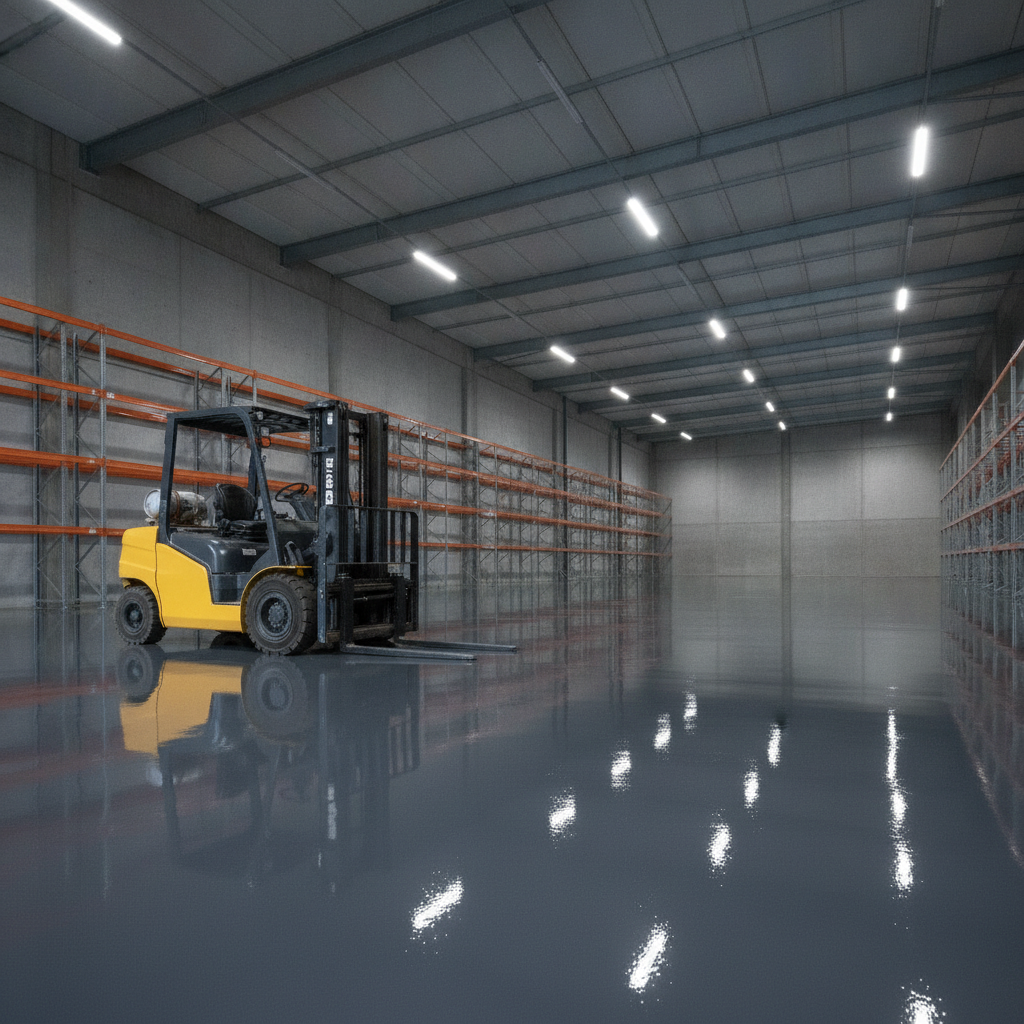
Industrial epoxy flooring is a two-part resin system applied directly over concrete to create a seamless, hard-wearing surface. It handles heavy machinery, forklift traffic, chemical spills and constant foot traffic without cracking or staining. For most Melbourne warehouses, factories and commercial workshops, it is one of the most practical and cost-effective flooring upgrades available.
What makes industrial epoxy flooring different from regular epoxy?
Industrial epoxy flooring uses a higher solids content than residential or light-commercial coatings, typically 100% solids formulations that cure into a film several millimetres thick. That extra build gives it the compressive strength to handle loads that would crack or delaminate thinner coatings. Standard residential epoxy is usually a thinner, water-based product suited to garages, not factory floors.
The practical difference shows up quickly under real working conditions. A light-duty coating might last three to five years in a domestic garage. A properly installed industrial system, with correct surface preparation and the right number of coats, routinely lasts ten to fifteen years in a working warehouse. The higher upfront cost reflects that longevity, not a premium for the label.
There are also performance grades within industrial epoxy itself. A distribution centre running pallet jacks needs a different spec to a food processing plant that hostes down the floor twice a day with caustic cleaners. Getting the spec right from the start is what separates a floor that holds up from one that starts peeling within eighteen months.
Which Melbourne workspaces benefit most from industrial epoxy flooring?
Industrial epoxy flooring suits any workspace where the floor takes sustained mechanical or chemical punishment. Warehouses, manufacturing plants, automotive workshops, cold storage facilities, food production kitchens and large commercial workshops are the most common candidates in Melbourne. If your floor is bare or sealed concrete that chips, dusts or stains regularly, epoxy is worth a serious look.
Warehouses are probably the clearest fit. Forklift tyres, steel racking legs and heavy pallet drops all concentrate enormous force on small areas of concrete. A quality epoxy coating spreads that load, reduces surface cracking and keeps the concrete from dusting, which matters a lot if you store products that cannot be contaminated by concrete particulate.
Automotive workshops benefit from the chemical resistance. Engine oil, brake fluid, transmission fluid and battery acid are all regular visitors to a workshop floor, and bare concrete absorbs every drop. An epoxy surface lets you wipe spills clean rather than watching them soak in and stain permanently. Many workshop owners also add a broadcast of fine anti-slip aggregate to the topcoat, which provides grip even on a wet floor without adding meaningful texture that traps dirt.
Food production and commercial kitchen environments need a slightly different approach. Here the focus shifts to hygiene. A seamless epoxy floor has no grout lines, no cracks and no porous surface for bacteria to colonise. That is a genuine food safety advantage, and it is why so many food manufacturers specify epoxy as a matter of course rather than preference.
What does a commercial epoxy floor installation actually involve?
A commercial epoxy floor installation starts with surface preparation, which is almost always the most important step. Concrete must be mechanically ground or shot-blasted to open the surface profile so the epoxy can bond properly. Skipping or rushing this step is the single biggest cause of delamination failures. On a sound concrete slab, preparation alone can take a full day before a drop of resin touches the floor.
After prep, any cracks, joints or hollow spots are filled and repaired. Then the primer coat goes down, followed by the body coats and finally a topcoat, often polyurethane or polyaspartic, which adds UV stability and extra chemical resistance. Depending on the system specified, the floor may need between two and four coats with cure time between each one.
For most Melbourne commercial jobs, you are looking at a two to four day installation window for a mid-sized floor, plus a cure period before the floor can take traffic again. Light foot traffic is typically possible after 24 hours, but full load bearing and forklift traffic usually requires 72 hours minimum. Planning the shutdown window around that cure time is a basic part of the project conversation.
Humidity and temperature affect cure times, which is worth knowing if your workspace has minimal climate control. Melbourne’s winters can extend cure schedules, particularly in poorly ventilated warehouse spaces. A good installer factors this into the job timeline rather than springing it on you afterwards.
How long does industrial epoxy flooring last, and what affects its lifespan?
Industrial epoxy flooring installed correctly over properly prepared concrete typically lasts ten to twenty years in a demanding workplace before a full recoat is needed. The exact lifespan depends on traffic intensity, the chemical exposure the floor sees, how well the surface was prepared and whether minor damage is patched promptly rather than left to spread.
The biggest lifespan killers are poor surface prep before installation, using an underspec product for the application, and ignoring small areas of damage once the floor is in service. A chip or crack left unrepaired lets moisture and contaminants work under the coating, and what starts as a small spot can eventually lift a large panel of epoxy off the slab.
Routine maintenance is straightforward. A daily sweep and a weekly scrub with a neutral pH cleaner is all most industrial epoxy floors need. Avoid acidic cleaners unless the topcoat is specifically rated for them, and avoid dragging steel edges directly across the surface. With that basic care, the floor will look presentable and perform well for a long time.
What should you ask before getting a commercial epoxy floor quote?
Before you call anyone out for a quote, think through a few basics: the total area in square metres, what the floor is currently used for, what machinery or vehicles run on it, whether there are existing coatings or sealers on the concrete, and whether there are any known moisture issues in the slab. Having that information ready speeds the quoting process and reduces the chance of surprises mid-job.
On the quote itself, ask specifically what surface preparation method is included. Diamond grinding and shot-blasting are the industry standards for commercial work. If a quote does not mention preparation at all, that is a red flag. Also check whether the quote includes crack and joint repairs, how many coats are specified and what the topcoat product is. Two quotes that look similar on price can be very different in scope.
References from similar commercial or industrial jobs in Melbourne are worth asking for too. A floor that performs well in a small cafe is a different proposition to one that survives three years of forklift traffic in a logistics facility. Seeing comparable finished work, or speaking to a client in a similar industry, gives you much more confidence than a brochure photo.
Metal and Flake works with commercial and industrial clients across Melbourne, bringing the same attention to surface preparation and product selection to every job. Enquire about commercial epoxy floor coating from Metal and Flake.