Commercial Epoxy Flooring Melbourne: Options for Every Business
Commercial epoxy flooring is a hard-wearing, resin-based coating applied directly to concrete to create a seamless, chemical-resistant surface. For Melbourne businesses, it covers everything from basic single-coat systems in warehouses to decorative metallic and flake finishes in showrooms. The right system depends on foot traffic, forklift loads, chemical exposure and the look you need.
What types of commercial epoxy flooring systems are available?
Commercial epoxy flooring systems broadly fall into four categories: standard solid-colour epoxy, decorative flake (broadcast) systems, metallic epoxy, and high-build industrial coatings. Each is designed for a different combination of durability, aesthetics and budget, so matching the system to your actual use case is the most important decision you will make.
Here is a plain-English breakdown of what each system actually does.
Solid-colour epoxy is the workhorse of the commercial world. It goes down as a single or two-coat system over prepared concrete, gives you a uniform gloss or satin finish and handles moderate forklift traffic, chemical spills and daily cleaning without complaint. Warehouses, cold-storage rooms and light-manufacturing spaces use it constantly because it is fast to install and easy to maintain.
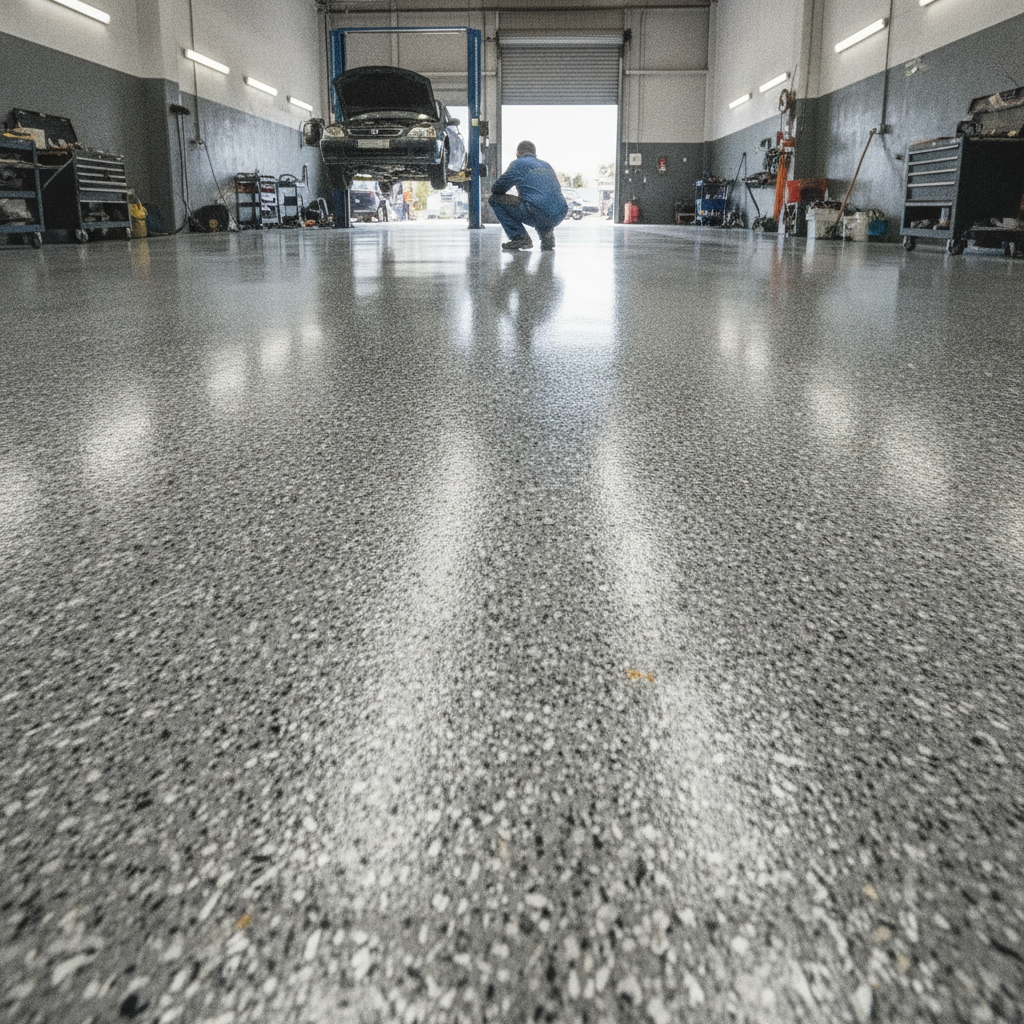
Broadcast flake systems scatter vinyl colour flakes into a wet epoxy base, then seal them under a clear polyurethane or epoxy topcoat. The texture hides minor scratches, the colour chip patterns mask dirt between cleans, and the topcoat adds slip resistance. That combination makes flake a favourite for automotive workshops, gyms, veterinary clinics and retail back-of-house areas where looks and practicality both matter.
Metallic epoxy uses pigmented metallic powders suspended in a clear epoxy base to create flowing, three-dimensional colour effects that look nothing like a painted floor. It is poured and manipulated while wet, so no two floors are identical. Boutique showrooms, hospitality venues and reception areas use metallic epoxy when they want a floor that functions as a design feature rather than just a surface to walk on.
High-build industrial coatings are thicker systems, often 3 mm to 6 mm, that include broadcast aggregate or quartz sand for maximum impact resistance and chemical protection. Food-manufacturing plants, chemical stores and heavy-engineering workshops rely on these systems because standard coatings simply are not thick enough to cope with the punishment.
How does commercial epoxy flooring hold up under heavy use?
A properly installed commercial epoxy floor, with correct surface preparation and an appropriate topcoat, will typically last 10 to 20 years under normal commercial use before it needs a full recoat. The two factors that shorten that lifespan fastest are inadequate concrete preparation before installation and choosing a system that is under-specified for the actual load and chemical exposure on site.
Concrete preparation is the part most people underestimate. Before any epoxy goes down, the concrete must be diamond-ground or shot-blasted to open the surface profile. Skipping or rushing that step means the coating bonds to surface dust and laitance rather than to the concrete itself, and it will peel. On a commercial site, a peeling floor means downtime, replacement costs and potential safety incidents, so the prep stage is never the place to cut corners.
Chemical resistance varies between systems. A standard solid-colour epoxy will handle oils, mild acids and cleaning agents well. If your site deals with strong solvents, concentrated acids or alkalis, a specialist chemical-resistant formulation or a vinyl ester system is the more appropriate choice. Being specific with your installer about what hits the floor regularly will save you an expensive remediation job down the track.
Slip resistance is another practical consideration for commercial spaces. A gloss topcoat looks great in a showroom but can become slippery when wet in a kitchen or wash bay. Anti-slip aggregate can be broadcast into the topcoat during installation to bring the surface up to Safe Work Australia guidelines without sacrificing much of the visual finish.
What should Melbourne businesses look for when comparing commercial epoxy flooring quotes?
When comparing commercial epoxy flooring quotes, look for three things: the specified film thickness in microns or millimetres, the surface preparation method listed, and whether the topcoat is included. A quote that skips those details is likely cutting costs in areas that will cost you more later. Ask for the product data sheets for the specific coatings being used so you can compare like with like.
Film thickness matters more than most business owners realise. A standard commercial two-coat system might apply 300 to 500 microns of total dry film thickness. An industrial system for a forklift-heavy warehouse might need 2 mm or more. If a quote does not specify thickness, you have no way of knowing whether you are getting a durable coating or a thin skim that will wear through in 18 months.
Surface preparation method tells you a lot about quality intent. Diamond grinding or shot blasting, both of which mechanically open the concrete surface, are the industry-accepted standard for commercial work. Acid etching alone is generally considered insufficient for floors that take vehicle traffic or heavy loads. If a quote lists acid etching as the only prep step for a workshop floor, ask why.
Downtime is a real cost for any operating business. Most commercial epoxy systems can be walked on within 24 hours and returned to vehicle traffic within 48 to 72 hours, depending on the system, the film build and the ambient temperature. Melbourne winters slow cure times, so scheduling installation in the warmer months, or using a faster-cure system, can reduce the time your operation is disrupted.
Finally, consider the total floor area and layout complexity. Open warehouse floors are straightforward and cost-effective per square metre. Floors with lots of drainage grates, saw-cut joints, columns and tight corners take longer to prepare and coat, which will be reflected in the price. A good installer will inspect the site and account for those variables rather than give you a per-square-metre rate over the phone without seeing the space.
Which Melbourne industries benefit most from commercial epoxy flooring?
The industries that get the most value from commercial epoxy flooring are those where the concrete floor takes daily punishment from vehicles, chemicals, water or heavy foot traffic. Warehousing and logistics, automotive workshops, food processing, retail and hospitality, aged care and medical facilities, and commercial gyms are the most common use cases across the Melbourne market.
Warehousing and logistics benefit because forklift tyres mark and erode bare concrete quickly, creating dust that contaminates stock and clogs racking hardware. A sealed epoxy surface stops that dusting, makes line markings far more legible and keeps the floor cleanable with a ride-on scrubber.
Automotive workshops deal with oil, coolant, brake fluid and tyre rubber daily. A flake system with a chemical-resistant topcoat handles all of those without staining, and the light-reflective finish improves workshop lighting without a single extra fitting.
Retail and hospitality spaces, particularly those in Melbourne’s competitive inner-city market, increasingly use decorative metallic or flake finishes as part of the fit-out because a quality epoxy floor costs less per square metre than polished concrete or large-format tiles, installs faster and still delivers a premium result.
Aged care and medical facilities value the seamless, grout-free surface because it gives bacteria nowhere to hide and can be sanitised with hospital-grade cleaners without degrading the coating. Those are compliance requirements, not just preferences, so the coating specification needs to match the relevant Australian standards for the facility type.
Whatever your industry, the principle is the same: choose a system matched to what your floor actually faces, prepare the concrete properly, and use a topcoat suited to your cleaning regime and traffic. Get a quote for commercial epoxy floor coating from Metal and Flake.